 Dean M. Cole
A Science-Fiction Author Accidentally Wanders Into a New Dark Matter Hypothesis
A Science-Fiction Author Accidentally Wanders Into a New Dark Matter Hypothesis
How A New Theory Made Me Rethink Dark Matter and Micro Black Holes
As a science-fiction author, I’ve made an entire career out of putting the fiction in science fiction when it comes to exotic physics. Wormholes, micro black holes, and multiverse gateways feature prominently in my Dimension Space books, a series of six novels that even garnered me fans amongst the theoretical physicists at CERN. These exotic spacetime structures are tools of the trade. They’re fun, dramatic, and only occasionally get me lectured by actual physicists.
But a few days ago, something unusual happened.
A new article in SciTechDaily challenged one of the most fundamental assumptions in black hole physics. It triggered an epiphany that blindsided me, and—if I’m reading the physics correctly—it may point toward a surprisingly elegant explanation for one of the biggest mysteries in the universe.
Dark matter.
And the route to that insight started with a physicist named Daryl Janzen and a paper arguing that:
Black holes may never fully form in the actual time flow of our universe.
That idea alone is worth a double-take. But when I combined Janzen’s argument with a concept I’d written about years earlier—the incredible energies of cosmic ray collisions—something clicked.
The result is a hypothesis I’m now running past someone who actually knows what she’s doing: a friend who’s a rockstar neutrino physicist at CERN.
While I wait for her response, I want to share the idea with you.
The Spark: “Black Holes Don’t Form the Way We Think”
Janzen’s argument focuses on a subtle but profound point about general relativity:
From the perspective of our universe’s external time coordinate, a collapsing star never actually crosses its event horizon. The collapse slows, freezes, and asymptotically approaches the horizon — but never completes.
If the horizon never forms in finite external time, then something else follows:
Hawking radiation cannot begin, because Hawking radiation requires a fully formed event horizon.
Let me repeat that:
If the horizon doesn’t exist yet, neither does evaporation.
This one insight unravels decades of assumptions about black hole thermodynamics.
And if Hawking radiation never gets started, then black holes—large or microscopic—don’t “boil away” the way we’ve always been told.
Which brings me to the second half of the epiphany.
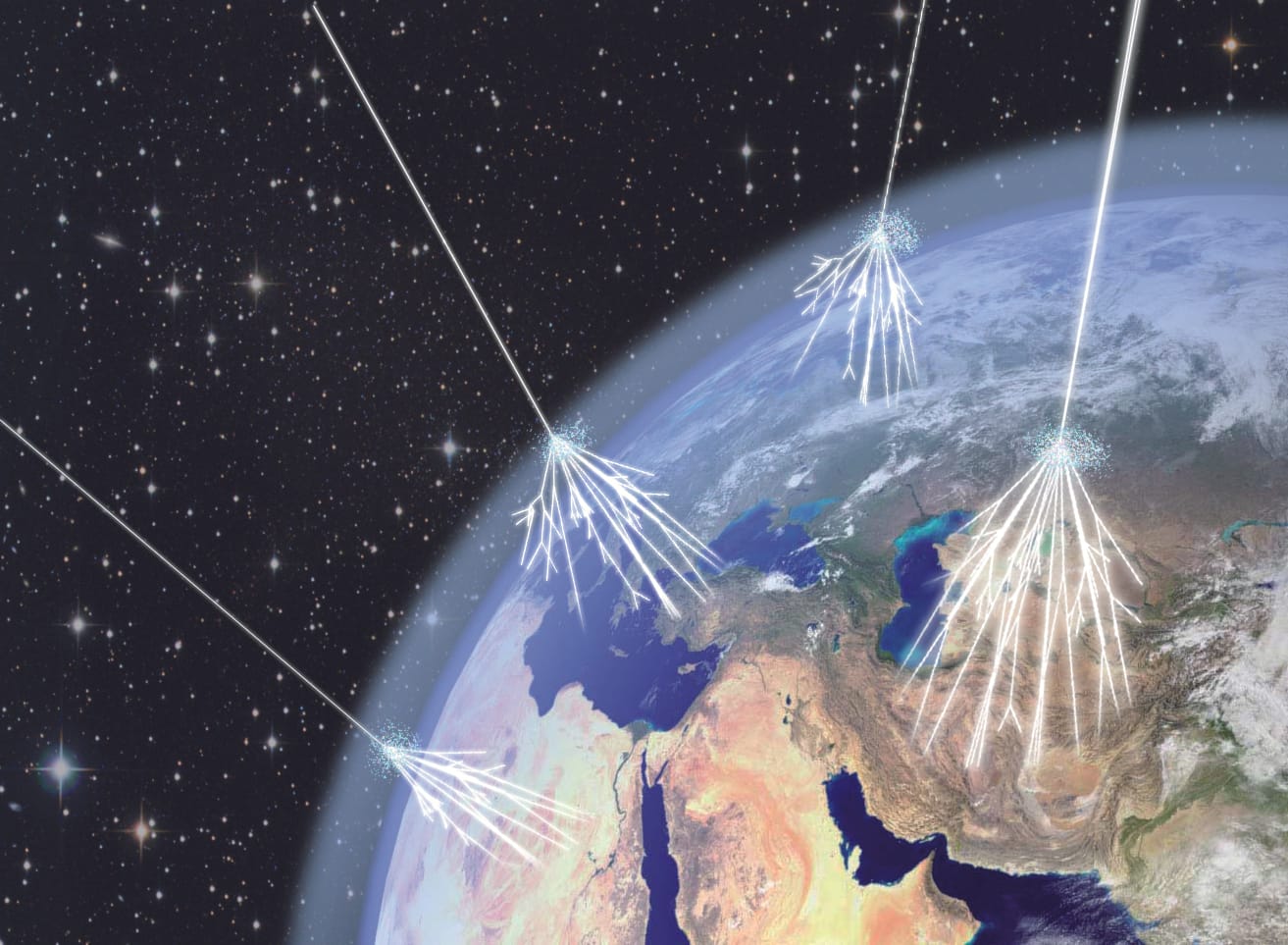
Cosmic Rays: The Universe’s Original Particle Collider
Years ago, I wrote a blog post about why we shouldn’t fear CERN creating micro black holes—despite what happens in my science fiction stories. My argument then was: the universe has already been smashing particles together at far higher energies via cosmic rays. If micro black holes were dangerous, we wouldn’t be here. And to be clear, this wasn’t just my point. It is the logic used by theoretical physicists for years to counter concerns about the potential negative effects of building larger and larger particle accelerators.
Cosmic rays routinely strike matter throughout the universe with far higher energies than CERN could ever reach, and they’ve been doing it for billions of years.
Those cosmic ray collisions don’t just happen in the upper atmosphere. They happen:
- in deep space
- on asteroids
- on planetary surfaces
- in the dense dust of stellar nurseries
- everywhere
If high-energy collisions can produce micro black holes, the universe has been manufacturing them nonstop since before galaxies existed.
Normally, physicists don’t worry about that because Hawking radiation is assumed to vaporize micro black holes instantly.
But what if Hawking radiation doesn’t activate in finite time?
What if micro black holes don’t evaporate at all?
Suddenly the universe wouldn’t contain a few micro black holes.
It would contain countless trillions and trillions of them.
A Thought Experiment That Makes Janzen’s Point Even Stronger
Here’s the part that drives home why Janzen’s argument resonated with me.
Because of extreme time dilation near an event horizon, an observer falling into a black hole would see the entire future of the universe, all the way to heat death, unfold in front of them before crossing the horizon.
This isn’t science fiction.
This is textbook general relativity.
As the infaller approaches the horizon, incoming light from the external universe becomes:
- infinitely blue-shifted
- infinitely compressed in time
- a torrent representing every remaining moment of cosmic history
If the observer could survive that (they couldn’t), they would literally watch the universe end before their foot touched the event horizon.
Think about what that implies:
The “moment” of event horizon formation, from the external frame, corresponds to the end of the universe.
No horizon in finite time.
No Hawking radiation in finite time.
No evaporation.
And if that’s true…
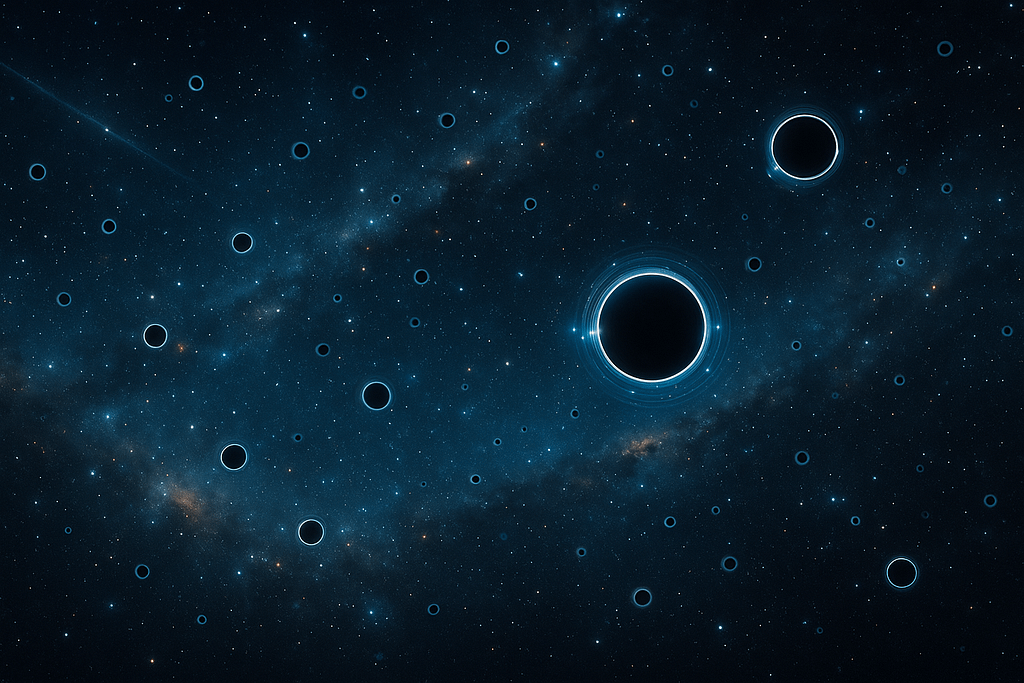
What If Micro Black Holes Are Dark Matter?
Here’s the epiphany:
If micro black holes are constantly produced by cosmic rays…
…and they never evaporate…
…and they interact only gravitationally…
…and they are extremely numerous…
…then they behave exactly like WIMPs (Weakly Interacting Massive Particles), which are the leading dark matter candidate, except without requiring any new physics or undiscovered particles.
They would:
- cluster in galactic halos
- shape galaxy rotation curves
- match gravitational lensing observations
- pass through normal matter invisibly
- be stable over cosmic timescales
In other words:
Micro black holes might be dark matter.
Not exotic particles.
Not supersymmetric leftovers.
Not axions or sterile neutrinos.
Just an overlooked consequence of general relativity + cosmic rays + a misunderstanding of horizon formation.
A universe quietly filled with uncountable gravitational seeds.
In addition to micro black holes potentially created by ultra-high-energy cosmic-ray collisions over billions of years, there may also be an enormous population of primordial black holes left over from the earliest fractions of a second after the Big Bang.
Cosmologists have long theorized that extreme density fluctuations in the young universe could have seeded black holes ranging from sub-atomic to planetary mass. Under the traditional assumption of Hawking evaporation, only the very large ones would still exist today. But if Hawking radiation never activates in finite external time, then every primordial black hole ever formed—no matter how small—would still be with us now, adding another vast reservoir of invisible mass to the cosmos.
This dual population—cosmic-ray-generated MBHs plus unevaporated primordial black holes—could together account for the full dark matter budget without invoking any exotic new particles.
Has Anyone Published or Written About This Precise Concept
After developing this idea, I did my due diligence. I searched the scientific literature. I searched the broader internet. I asked multiple independent AI systems. I found no record of anyone articulating this exact chain of reasoning—specifically:
Janzen’s finite-time horizon argument → no Hawking radiation → stability of cosmic-ray-generated MBHs → MBHs as the natural explanation for cold dark matter.
Other PBH (primordial black hole) theories exist, but none that I could find leverage this mechanism.
Could this be wrong? Of course. Could it be refined by real physicists? Absolutely. But is it a novel, internally coherent idea worth exploring? I think so.
What I’m Doing Next
I’ve sent a detailed summary of this idea to my friend at CERN. If she sees merit in it, or even identifies ways to sharpen or correct it, I’d love to work with her on formalizing it into a theoretical note or preprint.
In the meantime, I wanted to share it here because:
- it’s fun
- it’s surprising
- and it feels like one of those strange moments where fictional thinking stumbles into a potentially real idea
If nothing else, it’s been one hell of a thought experiment.
And if I’m wrong, at least I’ll get a chapter or two out of it … or perhaps an entire new series.










 Thank you to the Society Of Voice Arts And Sciences for nominating my narrative Dream Team, R.C. Bray and